
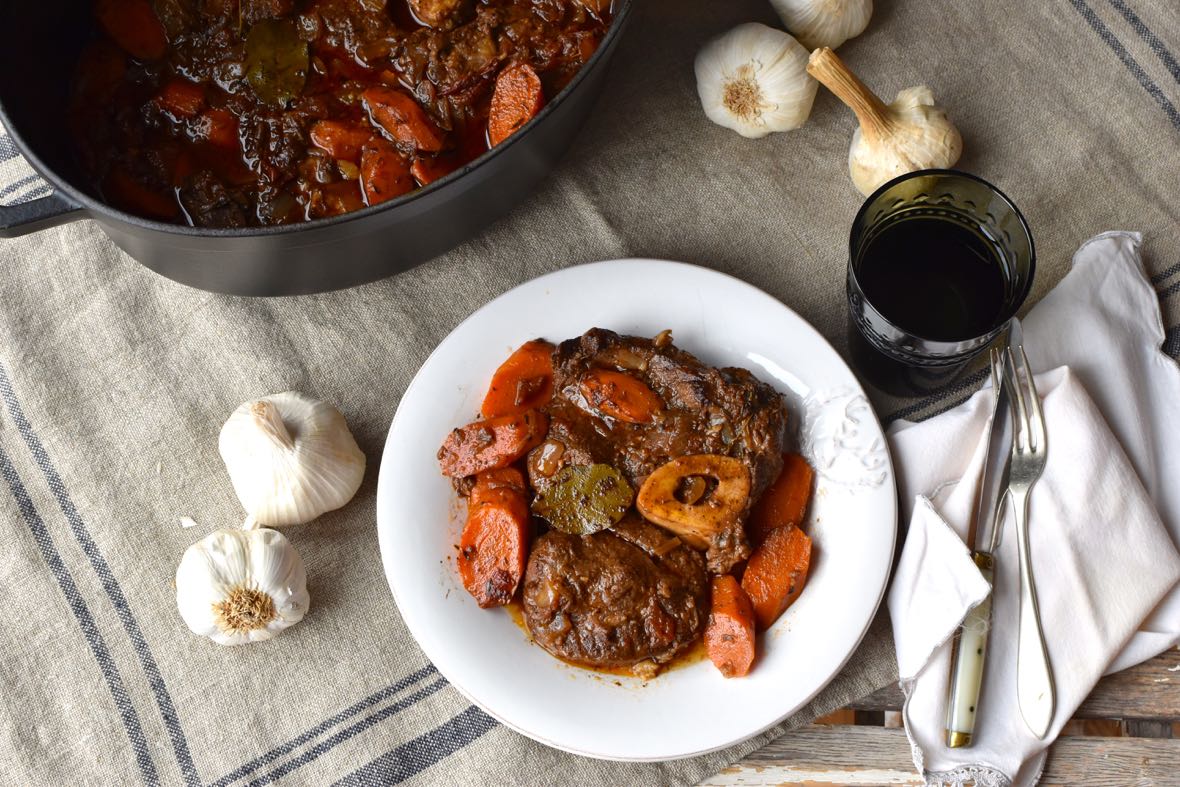
Beef shank with Wine and Pimentón sauce —and Maui and the Hawaiian islands
 If November 2024 started with a trip to London and Edinburgh, November 2025 hasn’t lagged behind in excitement, with a trip to beautiful Maui, in the Hawaii archipelago. A perfect excuse to accompany this post with a celebratory dish, beef shank with wine and pimentón sauce.

 But don’t get me wrong, I’m not saying beef shank with wine and pimentón sauce should only be made for a special occasion. It’s just that it’s one of those dishes that looks beautiful on your plate and at the same time, feels comforting — the kind of dish your children coming home for the holidays are craving and will appreciate.
Back to Maui.
It was an almost last minute trip that we enjoyed thanks to the generosity of my mother-in-law, Penny, and her brother Alan and his wife Jill, who own a gorgeous house in Wailea, on the southern coast of the island, that they graciously open to family and friends.


The turtles at Ho’okipa Beach

The town of Paia


Maui, like all islands in the Hawaiian archipelago, has a volcanic origin. In fact, the islands are a series of volcanoes rising from the ocean floor. They are formed by molten lava emitted through holes in tectonic plates that are slowly moving in the direction of Japan.
The Island of Maui, the second largest in the archipelago, is made up of two adjacent volcanoes, Haleakala and the West Mountains, which grew together at their bases as their peaks grew higher above the sea. The larger volcano is Haleakala, measuring over 10,000 feet high. Haleakala means house of the sun. A field trip to the Haleakala volcano was a must. I have to warn you, the drive up there has a lot of curves and it’s always uphill but it’s worth the trip. The landscape is almost moon-like, and breathtaking, and there you’ll find flora and fauna not found anywhere else, like the ahinahina or silversword (plant) and the nene (bird).


A bit of history
The Hawaiian islands and their people have an interesting history (and what history is not interesting!). It dates back at least 1000 years before the American colonies became a nation in 1776. The exact date when Polynesian people first set foot on these previously unhabited islands is, however, not known, since Hawaiians were a people without writing, who preserved their history through chant and legends.
Modern Hawaiian history begins on January 20, 1778, when Captain James Cook’s expedition first landed there. On that day, Hawaii‘s long isolation from the world beyond its horizons came to an end. From that moment on, traditional Polynesian society evolved through a series of cultural and social events that included: contact with Western technology and ideas, population decline, massive immigration of non-Polynesians, overthrow of the monarchy, a short lived republic, annexation as a US territory, World War II, and becoming the youngest American state.


Sun setting at Wailea
The Hawaiian people
The first newcomers to Hawaii were people of European ancestry, followed by Americans who came as explorers, adventurers, businessmen, whaling and merchant seamen and missionaries. Among the Caucasians who came in small groups as agricultural workers were Russians, Portuguese, Spaniards, Germans and Norwegians. Next to come in large numbers were the Chinese, with the first major group arriving in 1852; then the Japanese, Phillipinos, Koreans, Puerto Ricans and Samoans. Intermarriage with Hawaiians became common, to the point that today, only 1.5% of the Hawaii State population is of pure Hawaiian ancestry.
Missionaries
The majority of the missionaries who came to Hawaii in the earliest years came from Puritan New England. Judged by today’s standards many of their ideas were narrow and intolerant; however, they established schools throughout the islands that taught many subjects not connected with religion.


Sunset at Wailea

Sunset at Kihei
The missions also encouraged the development of agriculture and manufacturing with which to give Hawaii an economic base in trading with foreign nations. They introduced western medicine and undertook the kingdom’s first modern census. The missionaries must be credited also with helping Hawaii become and remain an independent nation at a time when Hawaii was ripe for colonization.
Father Damien of Molokai
The most famous missionary was, undoubtedly, father Damien, who in 2009 was canonized by Pope Benedict XVI to become Saint Damien of Molokai.
Father Damien was born in Belgium in 1840, baptized as Joseph de Veuster. He entered the congregation of the Sacred Heart at Louvain as a youth. In the 1860s, Hawaii was alarmed at the spread of leprosy, particularly among the native Hawaiian people. Medical opinion held that the only way to prevent further spread of the disease was to isolate the victims. The Hawaiian legislature chose lonely Kalawao, a peninsula on Molokai Island’s north shore, as the place of settlement. Kalawai became a sort of natural prison, surrounded on two sides by rough seas and at its back, cut off from the rest of the island by steep cliffs. The government planned to furnish farm animals, medical care, and regular shipments of food and other supplies.
 In 1866 the first boatload of patients was torn from their weeping relatives and departed from Honolulu. Upon arrival, they found that the so-called hospital had no beds, that medicines and doctors were in short supply, and that food shipments were undependable. The patients lived in sordid conditions and cast out from society. No attempt whatsoever was made to cure the disease.
After completing his training at Louvain, young father Damien was assigned to the Sacred Heart Mission in Hawaii. On a visit with his Bishop to the leper settlement, Father Damien was struck with the suffering and almost total abandonment of the victims. He remained behind and soon asked the bishop‘s permission that he’ll be allowed to stay and serve the lepers. He had decided to dedicate his life to the alleviation of the physical and spiritual misery of the sick.


Father Damien worked alongside the lepers, helping them to obtain food and warm clothing, build housing, and assure a supply of clean, potable water. He built chapels and orphanages. His enthusiastic and loving closeness to the unfortunate resulted in him contracting leprosy, but he continued to work. Eventually, his selfless labors were recognized, and the government undertook the responsibilities it had so long avoided. As the news of his dedication and his work spread throughout the world, funds and help came pouring in.
He died on April 15, 1889. Fellow lepers buried him, but in 1936, at the request of the Belgium government, his body was returned to the village of his birth. He was beatified by Pope John Paul II and subsequently canonized as a saint by Pope Benedict XVI.


I could go on about the many more aspects of the Hawaiian history, including its politics, its kings and queens and the fall of the monarchy, its strategic geographical location that became clear during World War II, its agriculture (pineapples! sugar!), its people’s traditions, including tattooing, and surfing… but this post would get too long, and it’s time to get cooking!


 I leave you with some photos of my trip to Maui, with the Haleakala volcano and the West Mountains, and the gorgeous beaches and towns we visited —Ho’okipa Beach with its surfers and turtles, the roosters roaming freely everywhere on the island, the colorful towns of Paia, Makawao, Kula and Kihei, a drive through Lahaina, where the effects of the devastated 2023 fires were evident, the sandy beaches of Wailea, where we practiced some snorkeling, and the relaxing walks along the sea shore.
Beef shank with wine and pimentón sauce is a delicious, comforting dish that looks rich on the plate but that is simple to make. The two hours simmering time allow you to set up a timer and forget about it, while you go about your day and tasks. The beauty of slow cooking.
Enjoy!

BEEF SHANK WITH RED WINE AND PIMENTON SAUCE
Equipment
Ingredients
- 2 beef shanks
- 1 Tbs flour
- 1/4 cup olive oil
- 5 shallots
- 6 garlic cloves
- 1 medium onion
- 3 carrots
- 3 tomatoes
- 1 lemon
- A few sprigs of thyme
- 2 bay leaves
- 1 cup Spanish red wine
- 1 tsp pimentón de la Vera
- Sea salt and freshly ground pepper to taste
Instructions
- Place the cocotte on the stove and heat half of the oil.
- Season the beef shanks with salt and pepper. Flour the meat on both sides and sear on the hot oil.
- Mince one of the shallots and add it, together with the pealed cloves of garlic, to the pan. Turn the meat over to sear on the other side.
- Peel the carrots and chop them transversally into about 1/2 inch thick slices. Chop the onion. Peel the remaining shallots.
- Pour the remaining olive oil in the pan. Add the onion, carrots and whole shallots and cook on medium heat until the onions are translucent, about 10 minutes. Season to taste with some sea salt.
- Peel and chop the tomatoes and add them to the pan. Add the sprigs of thyme, the bay leaves and two lemon strips. Cook for about 5 minutes, then add the wine and 1 cup of water.
- Cover and simmer for 2 hours. Then remove the lid and add the pimentón. Cook on low heat for about 25 minutes, or until the liquid reduces a bit.
- To serve, place a portion of beef shank over a bed of mashed potatoes, then top with the carrots and shallots and some of the sauce.

December 8, 2025 @ 7:32 am
¡Qué hermosas fotos de Hawaii!
Yo preparo un plato parecido con codillo de res, pero sin limón. ¡Lo probaré!
December 8, 2025 @ 11:42 am
Sí, Hawaii es una maravilla, con paisajes de contrastes muy llamativos.
Tu codillo de res suena delicioso. ¡Buen plato para celebrar estos días de fiesta! A ver si te gusta con el toque del limón.
Saludos,
Natacha xx