
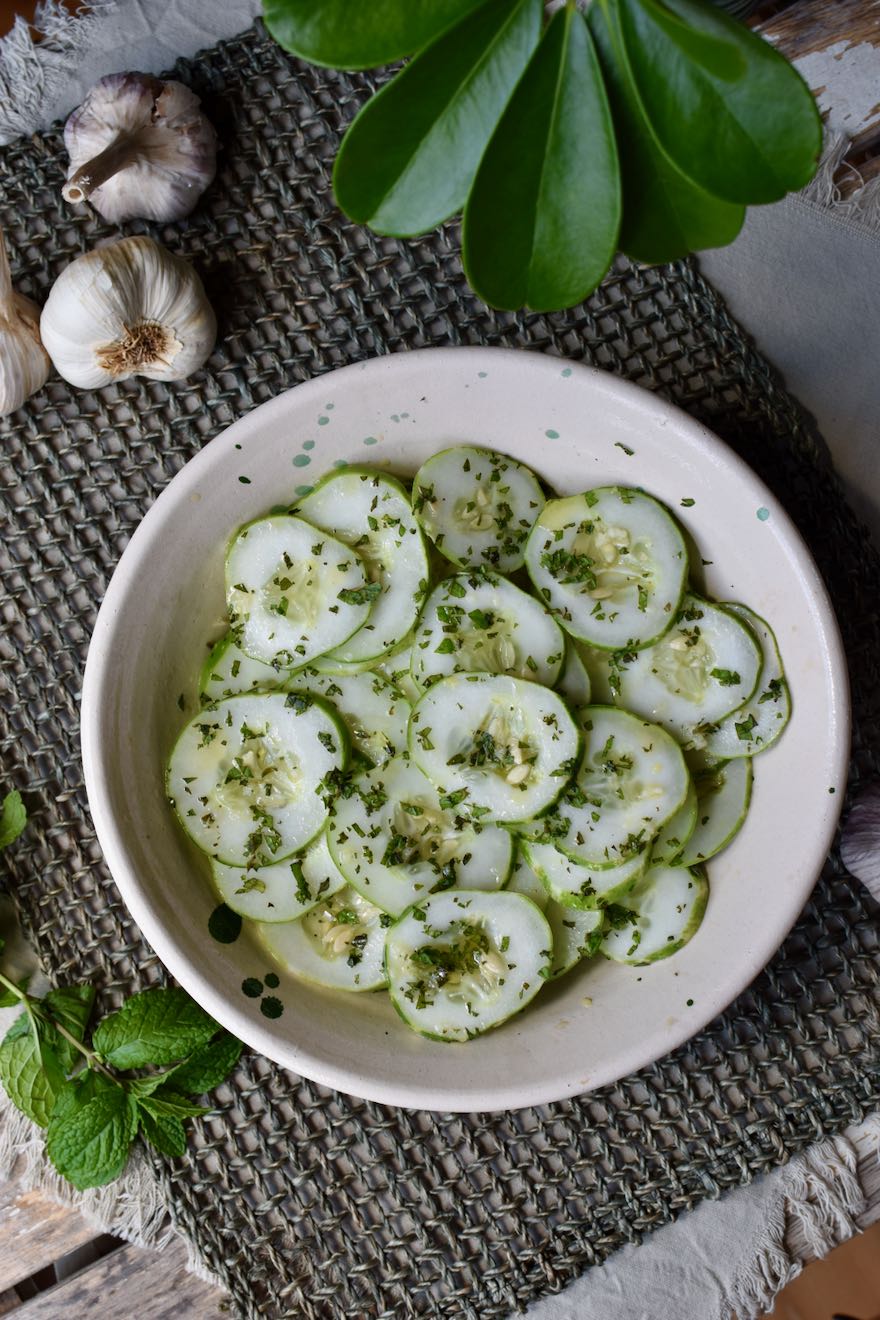
Cucumber Salad with Mint Dressing —and the Roman City of Tarragona
 The recipe I’m sharing today, cucumber salad with mint dressing, is so refreshing and so appropriate for these very high summer temperatures (particularly in Spain) that I wonder why I am publishing it towards the end of August.


Well, I guess one of the reasons is that my vegetable garden, my loved and pampered vegetable garden, hasn’t done very well this year. I don’t exactly know what the reason is – too much rain, or too little sun, or the fact that I wasn’t here for a month to take care of it this summer… Actually, I’ll scratch that last reason, because my wonderful friend Preeti took very good care of it. So it must be the weather. Truly, we’ve had so much rain since I came back from Spain that I don’t think I swam more than once since. And swimming is my favorite workout in the summer!
I have started to get a number of cucumbers lately, also peppers and eggplants. But the tomato plants look very skinny and sad, and I’m sure they’re wondering what happened to the sun, why isn’t it shining so they can get plump and juicy. I wonder about that too.

El Balcón del Mediterráneo, the Mediterranean Balcony


Praetorium and Roman Circus in Tarragona


While my vegetable garden hasn’t done terribly well, my herb garden is bursting. I’ve made a few batches of pesto sauce, and I have been able to dry oregano, thyme and rosemary to last me through the winter and until next spring. So what a perfect way to use the abundant mint that’s growing in my planters than in the dressing for this fabulous cucumber salad with mint dressing!
As for utensils, I swear by my Japanese mandolin. Even though I have a very powerful food processor (one of the items that I received as the winner of a Belgioioso contest for my recipe for passionfruit and berry cake with mascarpone icing), I really love using my manual mandolin. At about $40, nothing beats its quality and price.
I have been in the US for a few weeks now, but Spain is in full summer mode. So I have decided to accompany this post with a tour of the city of Tarragona, which we visited. Only 1 1/2 hours from our vacation place, I can’t believe we hadn’t visited yet.


On the streets of Part Alta


Tarragona’s Santa Tecla Cathedral
TARRAGONA
Tarragona is the capital city of the province of Tarragona, one of four provinces that compose the region of Cataluña – the other three are Barcelona, Lérida and Gerona, or as they would say it in the Catalan language, Barcelona, Lleida and Girona. It overlooks the Mediterranean, and it has one of the most active and busy ports in Spain. But Tarragona is not only beautiful because of its beaches and port, it is also known for its rich historic and cultural patrimony. In fact, Tarragona was one of the most important cities in the Roman Empire, called Tarraco back then. And today it’s a UNESCO world Heritage site.


Main entrance to the Cathedral in Tarragona

Paleochristian relief on the exterior of the Cathedral

Tarragona Cathedral contains the largest rose window in Catalonia

The impressive organ at the Cathedral


If you’re driving, one good place to start is parking in the underground garage under the Rambla Nova. Take the steps or the elevator and you will emerge at the end of this wide, modern and busy avenue, steps away from what is known as El Balcón del Mediterráneo, the Mediterranean Balcony. The stunning views in front of you will not fit in one single photo: a sweep of the eyes from right to left will present you with the maritime neighborhood of El Serrallo, the busy port, the picture perfect Mediterranean sea and finally, to the left, the ancient Roman Amphitheatre. I won’t blame you if you want to take a number of photos of each of these views.


The Cathedral’s Treasury and its magnificent Mudejar coffered ceiling
The Amphitheater
Steps down or through the very practical elevator you will reach the amphitheater itself, perfectly preserved for over 2000 years. It was built between the 1st and the 2nd century A.D. and it was located outside the walls of the city and near the sea. Amphitheaters were used for blood sports, such as gladiator fights and fights with wild animals, but they also featured athletics, juggling and other exhibitions. The amphitheater was also used for public executions. One of the most famous ones took place on January 2, 259, when the emperor Valerian, in his persecution against the Christian Church, martyred the bishop of Tarraco, Fructuoso, and his disciples Augurio and Eulogio. Around the 6th century, a basilica was built in the arena to honor them.

The cloister at Tarragona Cathedral

Treasures at the Cathedral Museum

Gothic paintings at the Corpus Christi Chapel


A collection of Gothic paintings
 In the 12th century, a Romanesque church dedicated to Saint Mary of the Miracle was built over the old basilica. In the 16th century, the Basilica became a convent and in the 18th century it served as a prison.
The amphitheater is a must see visit, and it connects through a short walk with the Forum, remains of which can be found among the alleys and the walls of the medieval old town.
The Part Alta
We continued our walk through the Part Alta of the city, the enchanting Medieval quarter, with its intriguing maze of narrow streets and stunning world-class monuments. We strolled through the quaint Plaza del Foro and Plaza del Rey, where we enjoyed some delicious tapas before reaching the cathedral.

Resting and cooling at Plaza del Foro, Forum Square

Roman details everywhere in the city of Tarragona

Strolling in Tarragona’s Part Alta

Impressive wall art everywhere

The Cathedral
The Catedral de Santa Tecla, or Tarragona Cathedral almost deserves a post on its own. Walking around its many chapels and admiring its treasures while listening to the history and interesting facts through the provided app (it comes included with the admission ticket) made me want to stay another day in this gorgeous temple to not miss any detail of what was being explained and I was admiring with my own eyes.
The cathedral was built on the site of the Temple of Augustus, the seat of Roman Imperial worship. This site was later transformed into a Visigoth cathedral and, after a hiatus during the Islamic period, it once again became a place of Christian worship in the early 12th century.


The cloister


Cute creatures at the fountains in the cloister
The current cathedral was built between the 12th and the 14th centuries with a design that’s halfway between the Romanesque and the Gothic, but given its origins, Roman, Visigoth, Romanesque, Gothic, Renaissance, Baroque and neoclassical traces can be found within its walls.
The cathedral has a Latin cross floor plan and, as an interesting fact, it contains the largest rose window in Catalonia. The organ, built in the 16th century at the height of the Renaissance, is located on one side of the central nave of the basilica, and it’s ornately decorated with medallions and a large number of cherubs. It also stands out for its two enormous and beautifully decorated doors.

Plaza de la Seu

Some more need to refuel at Plaza de la Font

We enjoyed some regional dishes

The ancient city walls, oldest Roman walls outside of Italy

Resting on our way to the Roman city walls
Without elaborating much more on the cathedral, I will point out the beautiful and peaceful cloister and the cathedral’s treasury, with its magnificent Mudejar coffered ceiling.
Plaza de la Font
From the cathedral, and being quite hungry, we walked through the narrow streets of Part Alta towards Plaza de la Font, a rectangular shaped square with the City Hall on one end and lined on both sides with restaurants, cafés and cocktail bars.
After refueling with some delicious Catalonian specialties, we walked towards the ancient city walls, the ramparts that surrounded the old city. Built between the 3rd and 2nd century BC, about a third of the original walls remain, and are the oldest Roman walls outside of Italy.

El Serrallo, the maritime district, with the best seafood restaurants

Fountains line the El Serrallo maritime district

The Church of Saint Francis at El Serrallo

Wall art at El Serrallo
El Serrallo
Our next stop was El Serrallo, the picturesque and charming fishermans neighborhood by the port. We walked through its lively promenade lined with fountains and with some of the top fish restaurants in town and where, not far from the fishing boats, the most luxurious and ginormous yachts were docked.
More sites to visit
We were quite exhausted by the end of the day, having seen and walked so much, and yet we hadn’t completed our wish list of sites to visit!
In our bucket list for a future visit:
- The Provincial Forum, dating 1st C. AC
- The Praetorium and Roman Circus, 1st C. AC
- The Paleochristian Necropolis and Museum Complex, 5th C. AC
- The Aqueduct, 1st c. AC

La Rambla Nova, Tarragona’s main comercial artery, was partly covered by umbrellas!

At the end of Rambla Nova is the Balcón del Mediterráneo, the Mediterranean Balcony
And if you visit and have more than one day to spare:
- Playa Larga, or “Long beach,” with a sprawling length of 675 m and soft, golden sand and blue waters, perfect for a swim.
- Playa Tamarit, Tamarit Beach, boasts a majestic castle that towers above the sea. Dating back to the 11th century, it was once used as a defensive stronghold against invading Berber and Ottoman pirates. These days, the castle is a premier venue for weddings, with a star-studded clientele including world famous soccer players.
- Strolling along the Rambla Nova, which links the Mediterranean Balcony with the Imperial Tarraco Square. A bustling 2 km long street that can be considered the vibrant heartbeat of Tarragona, lined by an endless parade of shops, cafés and eateries, and buzzing with people at any hour of the day, a favorite hangout for both locals and visitors alike.


Tarragona is one of Spain’s best kept secrets, being located only an hour and a half south of Barcelona and in a way, being overshadowed by it. But you will not regret one minute of your visit there, and in fact, you will appreciate the less crowded atmosphere as compared to its more popular “sister”.
Back to the cucumber salad with mint dressing, I used the classic cucumbers, the ones that grow in my garden, but if you like fewer seeds or no seeds at all, you can use English cucumbers. Also, I washed the cucumbers really well and didn’t peel them, but you can peel them if you prefer. The salad will be delicious no matter what. Just remember to slice the cucumbers really thinly.


CUCUMBER SALAD WITH MINT DRESSING
Equipment
Ingredients
- 2 cucumbers
- A bunch of fresh mint leaves
- 3 cloves of garlic
- 1/2 cup extra virgin olive oil
- 2 Tbs white wine vinegar
- 1/2 tsp sea salt
Instructions
- Mince the mint leaves finely and mash the cloves of garlic to form a paste.
- In a small bowl mix the mint, garlic, salt, vinegar and olive oil.
- Wash the cucumbers and slice them finely with the mandolin (I like slices no thicker than 1/8 inch).
- Place the cucumber slices in a medium bowl and pour over the dressing. Mix with two spoons and serve.
Notes
- You can use English cucumbers if you prefer
- You can mix the dressing in a jar. In fact, you can double the quantities and save half of it for another salad, the dressing keeps well in the fridge for a few days.

August 26, 2026 @ 9:12 am
Es una ensalada de verano deliciosa y hay pepinos creciendo en el huerto. Tendré que conseguir algo de menta.
Tengo amigos en Tarragona, es una ciudad muy hermosa.
August 26, 2026 @ 12:50 pm
Te la recomiendo, está riquísima y es muy refrescante. También no puedo dejar de recomendarte que visites Tarragona si tienes la ocasión de visitar a tus amigos, y por un mínimo de dos días, para poder disfrutar de todo lo que ofrece. ¡Yo volveré!
Natacha xx