Torrijas —and Spain’s love affair with bread
 It is the Easter season, and my favorite treat is torrijas! They can be enjoyed at any time of year, but In Spain they are traditionally eaten during Holy Week and Easter.
But what are torrijas, you ask? They’re a delicious sweet bread treat, and even though I hate to make the following comparison, this is how I explain what they are here in America when asked: torrijas are the Spanish version of the French toast. Yeah, I know, who knows what came first, the torrijas or the French toast, right? But French toast is popular in America, so that is my best way to explain torrijas.
 Cristo de la Palma during the Holy Week Processions (Onteniente, Spain)

Holy Thursday Procession, Maritime Holy Week in Valencia (Spain)
Differences between torrijas and French toast
There are some differences between the two. One of them has to do with the bread. When I was younger, for torrijas you would use two-day old baguette bread. Nowadays, bakers make special bread for torrijas, more brioche-like. At home, my mom made torrijas every time she had a day-old loaf of bread —because, as you probably know, in Spain, we only eat fresh bread, day-old bread has other uses, but it is not eaten as accompaniment for saucy dishes or in the very typical Spanish bocadillos (sandwiches made with crusty baguette bread, like the brascada).


La Soledad, Holy Week processions, Onteniente, Spain

Another difference between torrijas and French toast is in the milk used to soak up the bread: for torrijas, the milk is flavored with orange and cinnamon, which gives them a very particular and delicious taste.
Another main difference is that the bread, once soaked up in the flavored milk and drenched in egg, will be fried in olive oil instead of butter, which is what you would use for French toast.
And finally, the last difference is on what you pour on the finished product: for French toast, you will use maple syrup or some other syrup. Torrijas can be finished in different ways depending primarily on the region of Spain. In some parts, they’re drenched in honey. But my favorite way, and the way my mom always made them, is completely covered in a mixture of cinnamon and granulated sugar. So good!

Procesiones de Semana Santa. Sevilla. Miécoles Santo. Salida de la Hermandad del Baratillo

Ecce Homo, Holy Week Procession (Onteniente, Spain)


La Dolorosa, Holy Week in Onteniente, Spain
Torrijas for Holy Week and Easter
As I’ve mentioned earlier, we can enjoy torrijas at any time of year, but they are a staple during Holy Week and Easter. And just like Christmas doesn’t end on Christmas Day, but starts on Christmas Day, Easter doesn’t end on Easter Sunday, but it starts on Easter Sunday and lasts until Pentecost. So this is a perfect recipe to be sharing now!
Holy Week is particularly special in Spain, where people celebrate on the streets by accompanying the floats with images depicting scenes of Jesus’ Passion in street processions. I’ve talked about it on this blog —you can check it out here, here or here—, but if you have the chance, I encourage you to visit Spain during that time of year.


Bread in Spain
There are many recipes in the Spanish cuisine that use bread. The thing is, bread has been for centuries, and still is today, the most important basic foodstuff for Spaniards. Until not so long ago, in fact, every Spaniard ate an average of 2 pounds of bread per day. It is almost impossible to think of sitting around the table together without a loaf of bread to share.
People in Spain accompany many dishes with fresh bread, purchased at the bakery that very same morning. I have very vivid memories of my childhood when, after my mom prepared breakfast and we were sitting around the table enjoying it before heading for school, she would walk to the bakery and come back with a few loaves of bread. While we finished breakfast and brushed our teeth, she would prepare simple bocadillos with the crunchy, still warm bread, drenched in olive oil and sprinkled with some salt, that we would take to school, wrapped in aluminum paper, to be enjoyed during the midmorning break.

Varieties of bread in La Tahona del Abuelo, Valencia (Spain)


Bread is so important in the Spanish diet that after the Spanish Civil War, when hunger was prevalent, bread became the base —and sometimes the only element— of the Spaniards’ diet. My grandma, who had horrid memories of the war, always saved a piece of bread after a meal, “just in case”.
Good white bread is still the norm in Spain, even though in more recent years, many varieties of bread have popped up in the market, the so-called healthy breads —darker breads with whole grains or using other varieties of flour besides the traditional wheat flour.
Just like each region of Spain has their own cuisine, they also have their own way of baking bread, with some types of bread characteristic of that particular region. They all have one thing in common, though: bread in Spain is crusty.

 Among the different varieties of bread are the pan blanco or pan candeal, typical from Castilla; the pa assaonat in Valencia, the pa de pagès, in Cataluña and the Balearic Islands; the pan de cristal also in Cataluña; piquitos in Andalucía or borona in Asturias (made with corn), and the sopako, a very dark bread, in San Sebastián. Almost every village is proud of its own specialty, and as we say in Spain, sometimes bread is “comido con los ojos”, eaten with your eyes, because it not only tastes, but it looks so good.
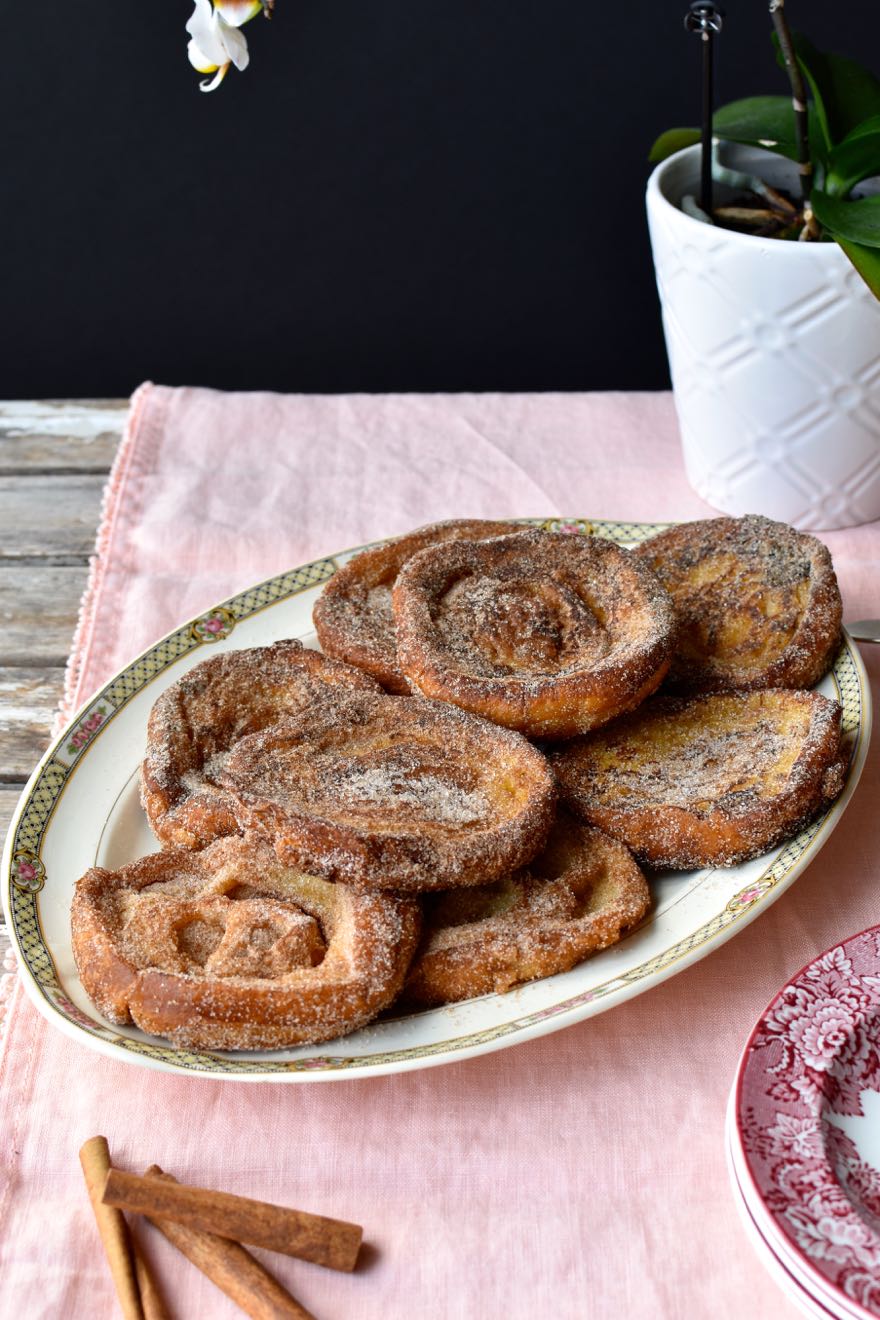
For the torrijas in this post I used brioche buns and they turned out really well. As you can see, my torrijas are round in shape, not the typical shape of a thick slice of bread that you would find in Spain, but they are just as delicious. One piece of advice: torrijas are better when just made, so make them and enjoy them!
I wish you a happy Easter season!

TORRIJAS
Ingredients
- 1 loaf of day-old bread or 4 brioche buns
- 2 cups whole milk
- 1 cup granulated sugar divided
- 3 eggs
- 3 cinnamon sticks
- Peel of 1 orange no white part
- 1 Tbs ground cinnamon
- About 1/2 cup olive oil
Instructions
- Slice the loaf of bread in 1 inch thick slices. Let the slices dry out until the next day.
- Place the milk, cinnamon sticks and orange peel in a saucepan and bring to a slow boil. Remove from the heat source. Add 1/2 cup sugar and stir to dissolve. Let the flavored milk cool down.
- Beat the eggs. Heat the oil in a medium size skillet. Working in batches (depending on how many slices will fit in the skillet), dip the bread slices in the milk and let them soak in it for several seconds. Then dip them in the beaten egg, covering both sides. Fry the bread slices in the hot (not smoking) oil, about 1minute per side or until golden. Remove from the skillet and place on a paper towel lined plate. Let them cool down.
- Place 1/2 cup sugar in a shallow bowl and mix in the ground cinnamon. One by one, dip the torrijas in the sugary mixture, making sure all sides are covered.
- Serve immediatly (preferred) with your coffee or hot chocolate.
Notes
- Torrijas can be a 2-day recipe: slice the bread loaf and let the slices dry out until the next day
- The quantity of olive oil for frying depends on the size of the skillet you use: bread should be submerged up to about half its thickness in the oil
- Torrijas are better enjoyed freshly made

April 23, 2026 @ 3:42 pm
¡Yo prefiero las torrijas!
Suelo comprar una barra de pan para el almuerzo y otra para la cena, porque se endurecen rápidamente. Luego uso el pan sobrante (duro) para hacer pan con tomate, picadas, etc.
¡Tus torrijas se ven deliciosas!
April 23, 2026 @ 4:43 pm
¡Claro que sí, muy a la española! Lo bueno del pan es que se puede comer fresco del día y luego utilizar el sobrante para otros usos, ¡no se desperdicia nada! Yo hice las torrijas con pan brioche y salieron riquísimas.
¡Gracias!
Natacha xx